Seasonal Watering Plan 2026-27
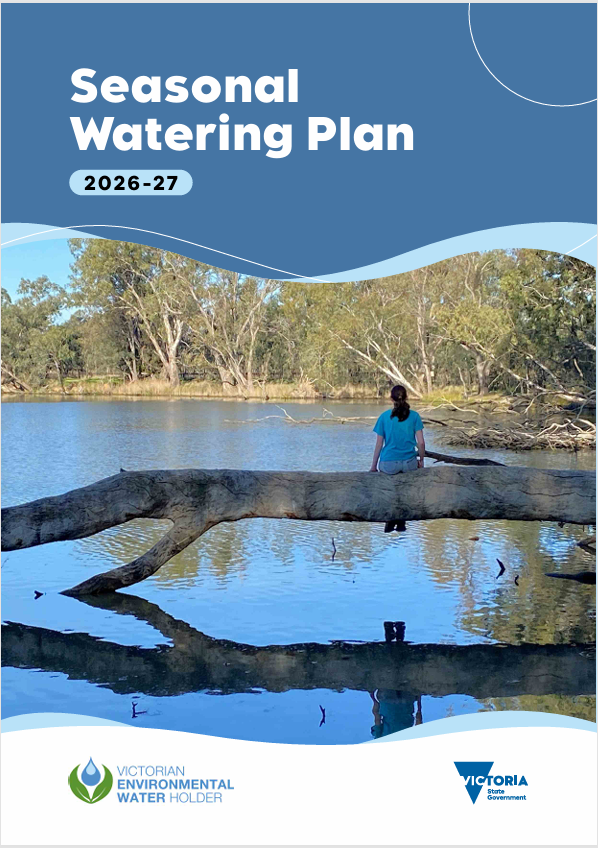
We are pleased to announce the Seasonal Watering Plan 2026-27 is now available to download from the Victorian Environmental Water Holder (VEWH).
You can also download
In the North East region, environmental water is delivered to the following waterways and wetlands:
Environmental Water Resources
The Environmental Water Resources Program funds an Environmental Water Resource Officer to undertake the Environmental Water Reserve (EWR) responsibilities outlined in the CMAs Statement of Obligations. This is an on-going program that is focused on the rules that protect and enhance the region’s flow regimes. This is primarily achieved through effective partnerships with Rural Water Authorities, Urban Water Authorities, catchment and local community groups, and Local, State and Federal Government departments to plan for the management of river health and water resources.
The Environmental Water Resources (EWR) Program aims to achieve improved waterway and wetland health through better understanding of water use, the regional water cycle and the environmental values that these provide for. The EWR Program implements Victorian water reform policy at the regional level, taking into account the regional issues related to the competing demands for water. It also ensures objectives for environmental water management are integrated into regional planning processes for rivers, wetlands, groundwater and broader catchment management.
Specific areas of focus are:
- Identification of environmental flow requirements for priority waterways and wetlands, which address all components of the flow regime through best available scientific knowledge.
- Identification of priority sites for environmental watering and drought refuges.
- Identification and development of structural works to facilitate environmental watering.
- Input into Victoria’s water allocation framework which protect environmental flows, such as Bulk Water Entitlements (BEs), Stream Flow Management Plans (SFMPs), and the management rules for unregulated rivers.
- Input into projects that allow new development whilst still protecting environmental flows in river systems, wetlands and groundwater. Projects could include measures such as trade, water efficiency and water re-use and recycling to improve environmental outcomes.
- Planning and co-ordinating the delivery of Commonwealth Environmental Water Holdings in the Ovens system.
- Monitoring and reporting of environmental water use
- Input into State programs that are contributing to the implementation of the Murray-Darling Basin Plan, for example: Victoria’s Long Term Watering Plans.
- Input into development, and implementation of State water reform for the North East region.
- Input into regional planning processes for rivers, wetlands and catchments to ensure that objectives for environmental water management are integrated with broader catchment management.
What is the Environmental Water Reserve?:
The Environmental Water Reserve (EWR) is the legal term used to describe the amount of water set aside to meet environmental requirements in Victoria.
Water provided for the environment provides a wide range of environmental benefits, such as boosting water quality (and reducing algal blooms) and providing cues for fish to spawn and birds to breed. Environmental water also boosts riverside and wetland vegetation, in turn creating habitat for wildlife such as platypus, frogs, turtles and migratory birds.
The EWR includes water provided through:
- environmental water entitlements: a volume of water held by the environment, that are generally a share of the available resource (inflows) in storages that can be released to meet specific environmental needs.
- passing flows: the volume of water that water corporations or licensed diverters are obliged to provide out of storage or past a diversion point before water can be taken for consumptive use.
- ‘Above cap’ water: the water available above limits on consumptive volumes of surface water and groundwater. Most water available to the environment is ‘above cap’ water, which can be a very unreliable source of water.
More information can be obtained through the Victorian Environmental Water Holder’s (VEWH) fact sheet for What is environmental water (PDF)
Why Do We Need Environmental Water?
Water within the environment is fundamentally important to the functioning of healthy rivers and wetlands, the plants and animals within our landscape, and the communities that surround them.
The North East region of Victoria contains some of the most in-tact flow regimes in the state; providing key economic benefits to communities through drinking water supply, agriculture, as well as being a key attraction for the many visitors to our area.
However, water regulation, extraction and drought all contribute to flow stress within waterways, reducing their ability to support environmental values, such as fish communities.
Environmental flows are defined as any managed change in a rivers flow pattern intended to maintain or improve river health. Click here to watch a short video on the importance of environmental water, and why we need it:
What Does Environmental Watering Involve?
There is a complex process that goes on before any environmental water can be released. Environmental water management involves a range of people and organisations. Relationships between local communities, the Catchment Management Authority, the storage managers (water corporations), environmental water holders, land managers and scientists are the foundation of environmental water management. This fact sheet ‘What does environmental watering involve?’ was developed by the Victorian Environmental Water Holder to outline the process.
Environmental Water Management Plans:
An EWMP is a scientifically-based management plan for a wetland or river system that provides a long-term (5 to 10 year) ecological objectives and watering requirements for the system. To date, the North East CMA have developed two EWMPs for the:
These EWMPS describe the:
- priority ecological values and functions present within the systems;
- long-term management goal for the system;
- priority ecological objectives for the system that environmental watering will support or improve; and,
- watering requirements of these ecological objectives to be targeted over the long-term (5 to 10 year hydrological regime).
EWMPs will be used to inform the development of Victorian seasonal watering proposals and seasonal water plans, as well Long-term Watering Plans that will be developed under Basin Plan requirements.
Unregulated Waterways:
Many of the waterways in the North East region of Victoria are unregulated. Unregulated waterways are those that do not have their flow controlled or modified by major dams or weirs. However, water can still be harvested from the river to fill farm dams, irrigate crops and for domestic, stock and town use. In dry years, consumptive demand has the potential to significantly reduce or stop flow. Low flows and cease-to-flow events can have negative impacts on aquatic fauna by reducing the quality or quantity of aquatic habitat.
In unregulated waterways there mechanisms and rules are developed to ‘leave’ enough water for the environmental values that rely on it.
The Upper Ovens River (upstream of Myrtleford) is a good example of how a high value unregulated waterway is being managed with the aim to improve the flow regime. A Water Management Plan for the upper Ovens was finalised in February 2012 which endeavours to ensure the water resources of the upper Ovens are managed equitably to ensure the long-term sustainability of those resources, thereby protecting the environmental, social, and economic benefits these water resources provide. The key environmental outcome of the plan is to reduce the risk to aquatic life during critical low flow periods by restricting surface water and groundwater diversion. This was the first plan developed within Victoria which considered both surface water and groundwater diversions equal due to their strong interconnection. The North East CMA are involved in on-going projects to provide greater certainty around whether the current water diversion rules provide critical instream habitat for Upper Ovens River during periods of low flow.
Recognising the recreational benefits of environmental water:
While environmental water is primarily focused on maximising environmental benefits for Victoria, there are many additional recreational benefits.
Links:
VEWH: www.vewh.vic.gov.au
CEWO: Commonwealth Environmental Water Holder - DCCEEW
Murray Darling Basin Authority: www.mdba.gov.au